need to find this book:
Forty Thousand Blue Days
and listen to this:
Burning Both Ends: When Oliver Reed Met Keith Moon
need to find this book:
Forty Thousand Blue Days
and listen to this:
Burning Both Ends: When Oliver Reed Met Keith Moon
Yes a web site all about felt!
OutBackFibres
If you see corrupt graphics in the SSMS window, as if windows is failing to update the window like this:

Then open the compatibility section for SSMS and tick the “Disable Scaling on High DPI settings”
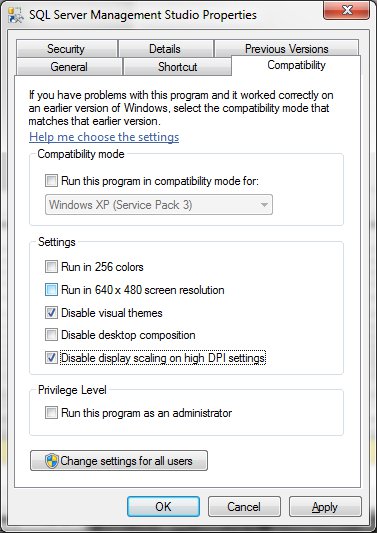
Should fix it.
Create a DLL for use in other programs using the MSDN web site
Kuksi, look at the quality of that chisel work!
Rank things in the table…..very usefull for more complex stuff
SELECT
    --your select bits here
,(Select count(*)	FROM YOUR_TABLE_NAME as internal
WHERE internal.refrl_refno=external.refrl_refno
AND internal.start_dttm
Age groups...

Slot these into a CASE END Sandwich
When age between  0 and  4 then '00-04'
When age between  5 and  9 then '05-09'
When age between 10 and 14 then '10-14'
When age between 15 and 19 then '15-19'
When age between 20 and 24 then '20-24'
When age between 25 and 29 then '25-29'
When age between 30 and 34 then '30-34'
When age between 35 and 39 then '35-39'
When age between 40 and 44 then '40-44'
When age between 45 and 49 then '45-49'
When age between 50 and 54 then '50-54'
When age between 55 and 59 then '55-59'
When age between 60 and 64 then '60-64'
When age between 65 and 69 then '65-69'
When age between 70 and 74 then '70-74'
When age between 75 and 79 then '75-79'
When age between 80 and 84 then '80-84'
When age between 85 and 89 then '85-89'
When age between 90 and 94 then '90-94'
When age between 95 and 99 then '95-99'
Create a table variable...
DECLARE @sw  table
(
field_refno numeric
, var_field varchar(10)
)
INSERT INTO @sw VALUES(1,'Hudgle')
Using HAVING
SELECT
	count(prvsp_refno) as N
	, patnt_refno
FROM 	provider_spells
WHERE
	inmgt_refno=200870
	and admit_dttm > '2008-01-01'
GROUP BY patnt_refno
HAVING
	count(prvsp_refno)>10
Extract the time:
--get the time as an hour
DATEPART(hh,getdate())
Extract the dayname:
--get the day as a word (short)
UPPER(left(datename(dw,getdate()),3))
--get something nicely formatted.
substring(convert(char,getdate() ,120),12,5)
Create a table full of sequential date_time
USE tempdb
DECLARE @t int
DECLARE @inc_date datetime
SET @inc_date = '2001-01-01 23:59:59'
--CHANGE THIS TIME TO GET DIFFERENT SNAPSHOT TIME first date and time of temp table

--if the temp table exists drop and recreate with the date time supplied above
IF  (SELECT '1' as exist_ WHERE exists (select '1' from sysobjects  WHERE  name='##Temp_dates')) = '1'
	BEGIN DROP TABLE  ##Temp_dates END
--create the table
CREATE TABLE ##Temp_dates(t_date datetime NOT NULL PRIMARY KEY)
	SET NOCOUNT ON
WHILE @inc_date <= '2012-12-31'
	BEGIN
	INSERT ##Temp_dates (t_date) VALUES (@inc_date)
	SET @inc_date = @inc_date + 1 --or decimal value for hours 0.5 etc..
	END
Convert calendar month number to financial year month number i.e. April = 1 rather than 4
In the following DTTM = Your date field
(MONTH([DTTM])+8)%12+1
Obtain Financial year from a date.
CASE WHEN MONTH(DTTM) IN (1,2,3) THEN CONVERT(CHAR(4),YEAR(DTTM)-1)+'/'+CONVERT(CHAR(4),(YEAR(DTTM)))
ELSE CONVERT(CHAR(4),YEAR(DTTM)) +'/'+CONVERT(CHAR(4),YEAR(DTTM)+1) END as fyear
Some Automatic Dates:
--first day of current month
DATEADD(MM, DATEDIFF(M, 0, GETDATE()), 0)

--first day of previous months
DATEADD(MM, DATEDIFF(M, 0, GETDATE())-1 , 0)

--last day of previous month
DATEADD(ms,-2,DATEADD(MM, DATEDIFF(M, 0, GETDATE()) , 0))

--tomorrow evening
DATEADD(ms,-2,DATEADD(dd, DATEDIFF(d, 0, GETDATE())+2 , 0))
…or swap the getdate() to a field to get the appropriate conversion from a field.
Select the first day of the current financial year…
case when month(DTTM) between 4 and 12
then DATEADD(MM, DATEDIFF(M, 0, DTTM)-(month(DTTM)-4) , 0)
else   DATEADD(MM, DATEDIFF(M, 0, DTTM)-(month(DTTM)+8) , 0) end
Link to youtube video:
Prelude